
The Executive’s Meditation Paradox: Why Busy Leaders Need It Most
I was curious when someone first suggested meditation. Managing $287M+ in revenue at global tech firms, I had plenty of reasons to dismiss it.
But curiosity won.
The first attempt? Frustrating. The guided meditation instructions sounded simple until I tried following them. I wasn't sure if I was doing it right. My achievement-oriented mind kept searching for an objective to meet, a goal to hit, a way to measure success.
That's when I learned something important: meditation is an ongoing exploration, rich with discovery.

From Frustration to Discovery: Learning to Meditate as an Executive
Once I gave myself permission to explore without needing to "get it right," something shifted. The practice felt invigorating.
I discovered that cultivating stillness on the meditation cushion wasn't the end goal. Rather, cultivating stronger presence throughout the rest of my day was. The paradox surprised me.
First, I learned to cultivate presence in challenging situations. This resulted in sharper focus and increased confidence when facing uncertainty.
Second, as that presence deepened, I found seeds of creativity and adaptability. This served me well when leading through technological and organizational changes.
What the Science Says About Meditation and Executive Functioning
It turns out there's a neurological reason for that shift. Research shows that mindfulness meditation increases cortical thickness in the prefrontal cortex and anterior cingulate cortex—the brain regions critical for decision-making, problem-solving, and self-regulation. Brief meditation training (as little as 5-10 minutes) improves executive attention while reducing stress hormone levels.
“Mindfulness meditation increases cortical thickness in the prefrontal cortex and anterior cingulate cortex - brain regions critical for decision-making and self-regulation. Brief meditation training (5-10 minutes) improves executive attention while reducing stress hormones. ”
If you're newer to meditation and wondering whether an app is the right starting point, I explore that question in depth in Meditation Apps vs. Personalized Guidance: Which Do You Need Right Now?.
The Real Test: Using Meditation to Lead Through Uncertainty
Theory is one thing. Application is another.
I was offered a new leadership position launching services across the North American market. The services were being built globally, and our company was headquartered outside our region. Incorporating feedback from North America was vital to success, but it was a tall task.
Most executives in that situation would push hard, advocate loudly for their region's needs. I would have done that, too.
My meditation practice showed me a different path.
It helped me practice what intercultural competence taught me: listening well and asking important questions creates the foundation for meeting client needs. The practice gave me the deep focus and influence necessary to collect data from our region that ultimately demonstrated to global colleagues how the solution needed to be built for North American success.
How Meditation Helps Leaders Navigate Workplace Resistance
My North American colleagues resisted providing the data. They were concerned their needs wouldn't be addressed, yet they'd still be held accountable for results based on that data.
Navigating that uncertainty required shifting quickly between quantitative and qualitative skills.
Here's what meditation actually did: it helped me reduce my stress responses and enabled sustained focus with executive functioning.
SAP documented similar results.
Corporate Mindfulness ROI: What SAP's 15,000-Person Program Proved
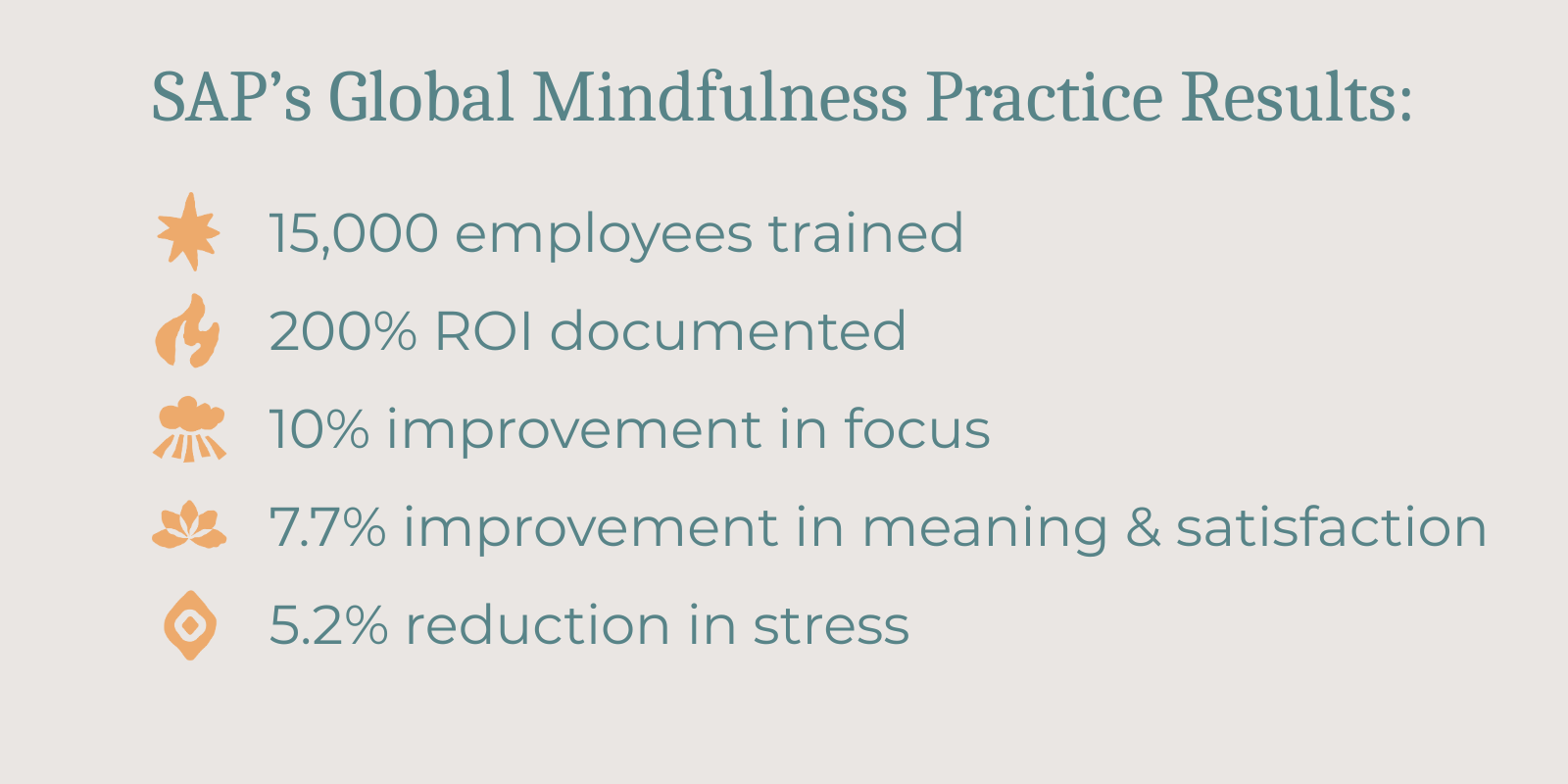
Under Peter Bostelmann's leadership as Chief Mindfulness Officer, SAP's Global Mindfulness Practice trained over 15,000 employees. They measured a 200% return on investment, with a 10% improvement in focus, 7.7% improvement in meaning and satisfaction, and 5.2% reduction in stress.
Using Mindfulness to Manage Stress Responses at Work
When colleagues push back, the natural response is to rush and push through resistance. After all, time is short and company success is on the line.
That's the fight response. It's well documented as one of the stress responses: fight, flight, freeze, or fawn.
Meditation helps you quickly recognize this reaction for what it is. You can set aside the individually motivated desire to steamroll people (even when title and authority are on your side) and choose a more powerful response.
What Regular Meditation Does to the Amygdala—and Why Leaders Should Care
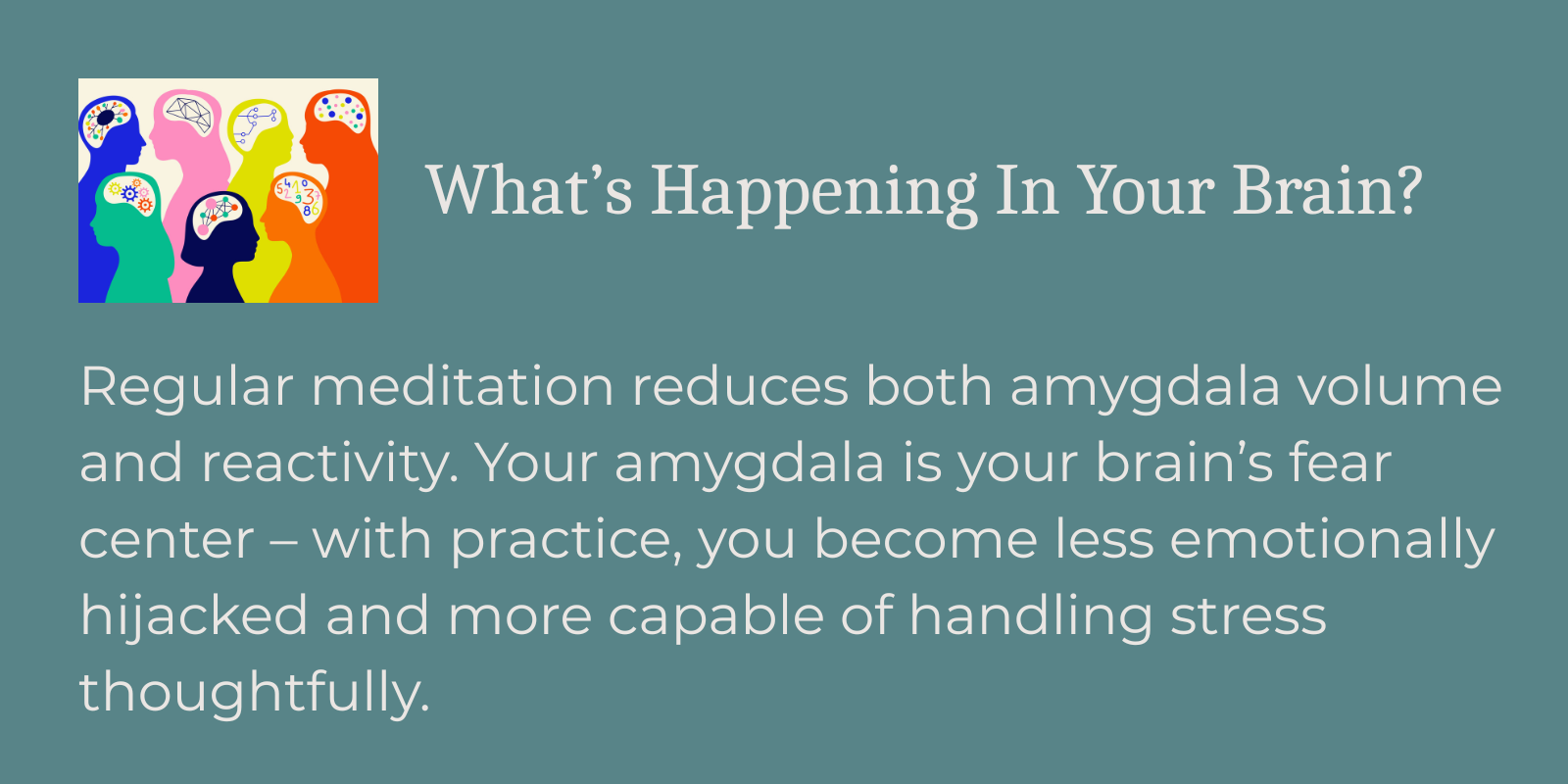
Research shows that regular meditation reduces both amygdala volume and reactivity. The amygdala is your brain's fear center, designed to detect danger and launch the fight-or-flight response. With practice, you become less emotionally hijacked and more capable of handling stress thoughtfully.
With stress responses in check, you have a wider range of possible responses. You have access to your best, most creative, and deeply focused thinking. From there, you can tailor your response based on the situation.
This is also where coaching and meditation intersect most powerfully. In Meditation Apps vs. Personalized Guidance, I describe how coaching client DeAngelo used on-the-spot mindfulness practices—not just morning sessions—to regulate his nervous system during important investor meetings. That kind of in-the-moment regulation is a learnable skill.
Applying Meditation Skills to Real Leadership Challenges
I took an incremental approach.
I enlisted my peers in North America to identify the most important prospects and clients. I enlisted my global colleagues to more fully understand our clients' and prospects' challenges by talking with them directly.
With that foundation, we established enough trust to build the budget collaboratively.
That budget was successful in shifting the development focus of the new solution to better meet the needs in our market.
Without meditation, I would have pushed harder, talked more, and listened less. The outcome would have been different.
“Without meditation, I would have pushed harder, talked more, and listened less. The outcome would have been different.”
How Fortune 500 Leaders Use Meditation for Competitive Advantage
Ray Dalio, founder of Bridgewater Associates (the world's largest hedge fund managing $150+ billion), calls meditation "the single most important reason for whatever success I've had."
He practices Transcendental Meditation twice daily for 20 minutes. He describes each session as a "20-minute vacation" that enables better business decisions. Dalio credits meditation with enhancing his "open-mindedness, higher-level perspective, equanimity, and creativity."
Jeff Weiner, former CEO and current Executive Chairman of LinkedIn, identifies mindfulness as foundational to compassionate management. He advocates becoming "a spectator to your own thoughts, especially when you become emotional."
Weiner credits mindfulness with enabling him to put himself in his team members' shoes to better understand their challenges. He emphasizes that cultivating trust through compassionate management enables "making high quality decisions faster."
The Organizational Case: Why Google, Apple, and Airbnb Prioritize Mindfulness
Leading Fortune 500 companies including LinkedIn, Google, Apple, Nike, Spotify, and Airbnb actively promote meditation to their employees. Research shows that companies introducing mindfulness programs see up to 200% ROI, with benefits including increased creativity, decreased reactivity, and increased productivity.
“Meditation doesn’t require finding extra time. It multiplies the effectiveness of the time you have.”
Skeptical about whether meditation is right for your specific context? Read Why Skeptical Executives Are Adding Meditation to Their Toolkit, where I walk through what actually changed the minds of accomplished leaders who started exactly where you are.
The Meditation Time Paradox for Busy Executives
The most common objection I hear: ‘I don't have time to meditate.’
I understand. I said the same thing.
But here's what I learned: meditation doesn't require finding extra time. It multiplies the effectiveness of the time you have.
You don't need to sit cross-legged for hours. Brief, guided meditation (5-10 minutes) outperforms hours of unfocused effort.
Studies published in the Proceedings of the National Academy of Sciences documented that even brief meditation training improves executive attention, mood, and immune function while reducing stress hormone levels.
Reframing Meditation as Essential Infrastructure, Not Optional Self-Care
Think of it as essential maintenance rather than optional self-care.
You wouldn't skip maintaining critical infrastructure in your organization. Your mind deserves the same priority.
The Ripple Effect: How Executive Meditation Transforms Organizations
Individual meditation practice benefits entire organizations.
When you're more present, less reactive, and thinking more clearly, everyone around you benefits. Your team makes better decisions. Your organization moves faster. Your leadership creates space for others to do their best work.
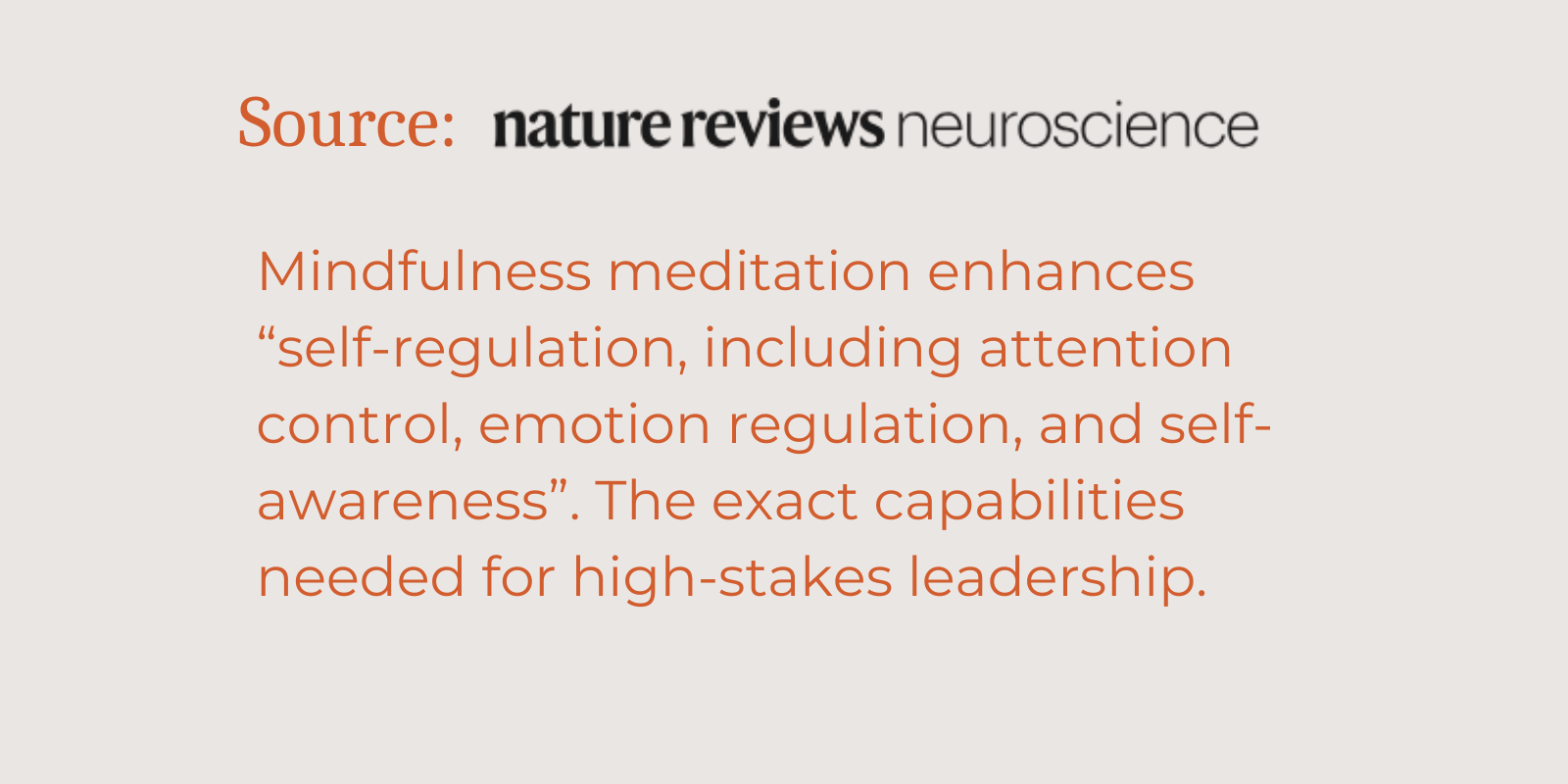
The Nature Reviews Neuroscience concluded that mindfulness meditation works through "a process of enhanced self-regulation, including attention control, emotion regulation and self-awareness". The exact capabilities needed for high-stakes leadership in uncertain environments.
My meditation practice didn't make me less ambitious. It made me more effective at achieving ambitious goals.
It didn't slow me down. It helped me move faster by eliminating the noise and focusing on what mattered.
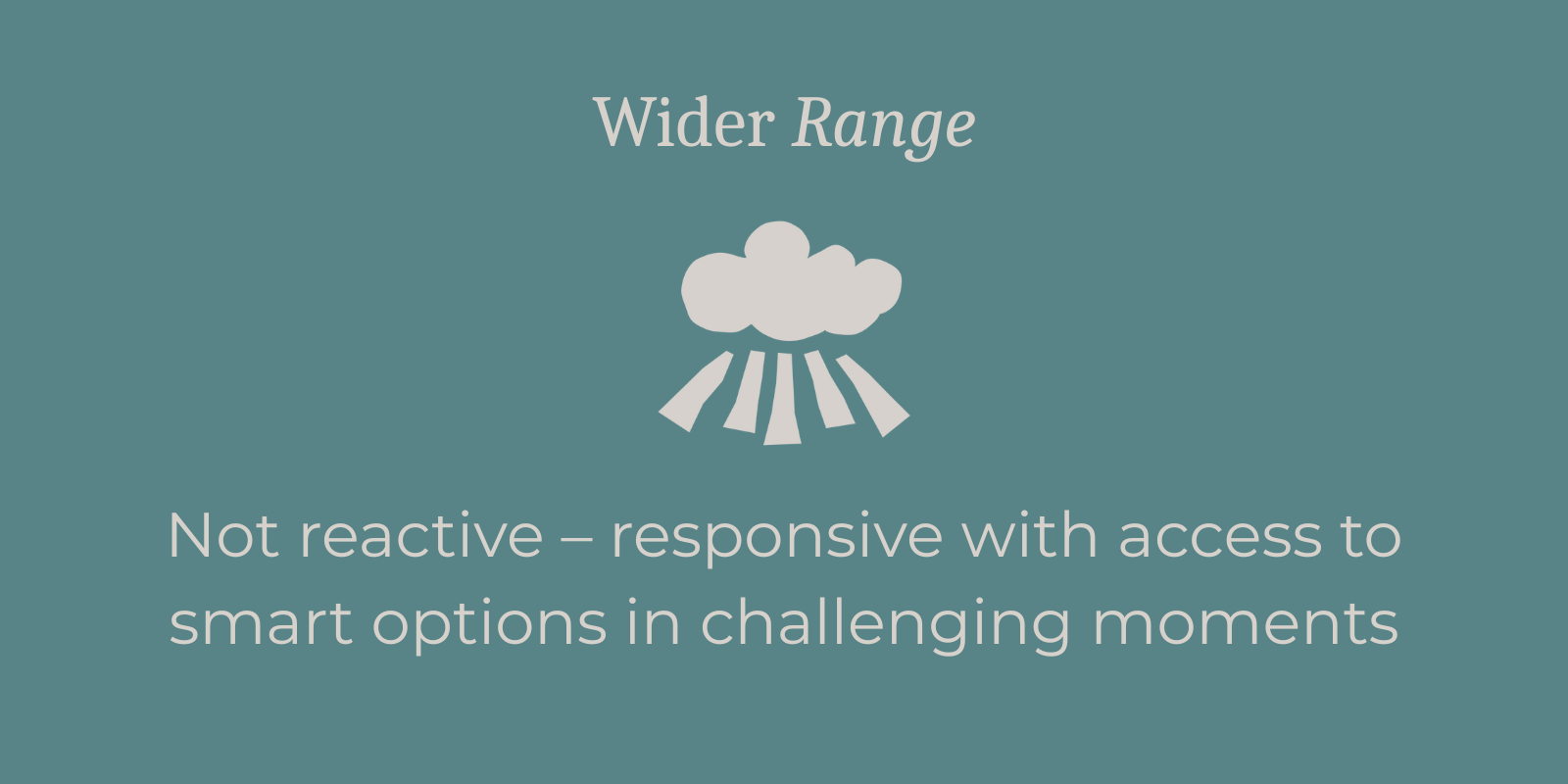
It didn't make me weaker. It made me stronger by giving me access to a wider range of responses in challenging moments.
Three Key Transformations from Executive Meditation Practice
My meditation practice didn't make me less ambitious. It made me more effective at achieving ambitious goals. It didn't slow me down. It helped me move faster by eliminating the noise and focusing on what mattered. And it didn't make me weaker. It made me stronger by giving me access to a wider range of responses in challenging moments.

Cross-Category Connections: Where Meditation Meets Coaching and Leadership
This post lives at the intersection of Enliven's three primary domains of expertise. The mindfulness and meditation foundation described here is the same one that informs the executive coaching work — from burnout prevention to executive presence — covered in Why Skeptical Executives Are Adding Meditation to Their Toolkit. And it connects directly to corporate and organizational development: when a leader's internal capacity grows, team dynamics, decision quality, and organizational culture follow.
Getting Started with Meditation for Busy Leaders
You don't need to become a meditation expert overnight.
Whether you start with 5 minutes, or work up to 20 like Ray Dalio, brief practice delivers results. Find a guided meditation that resonates with you. Give yourself permission to explore without needing to get it right. The goal isn't perfection. The goal is practice.
I've been where you are. Managing significant revenue, leading through uncertainty, feeling the weight of consequential decisions with limited time. Meditation became my competitive advantage. Not despite my busy schedule, but because of it.
The executives who need meditation most are often the ones who think they have the least time for it.
That's the paradox.
And that's exactly why it works.
Ready to Give It a Go?
Check out this guided meditation I created specifically for busy professionals.
Want personalized guidance rather than a solo start? Book a free discovery call to explore whether one-on-one coaching or a group mindfulness class is the right fit for where you are right now.
About Enliven
We help individuals like you meet challenges and navigate transitions with clarity and confidence. Through tailored executive coaching and individual coaching, we support executive and spiritual growth from the inside out.
Sessions are available by phone, Zoom, or in person at the Peachtree Corners Roam Workspace location the Atlanta area.
More from the Enliven Blog
Search BlogsBlogs by Category